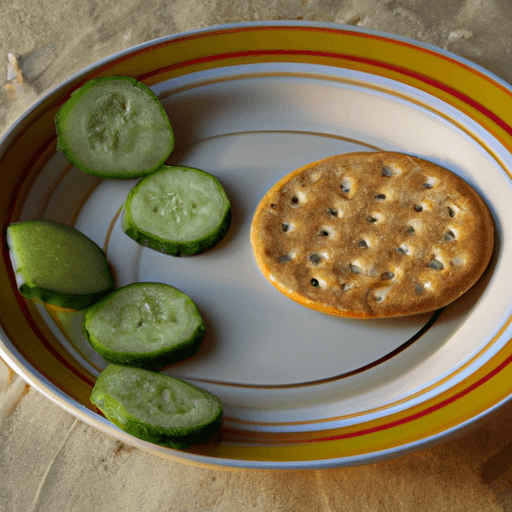
Does wet food pick up more germs than dry food when dropped on a surface? You drop cucumber slices (wet) and cheese crackers (dry) onto four locations for 20 seconds each. The locations include a kitchen sink, toilet floor, car porch, and garden grass.
You swab the food surfaces and transfer the samples to agar Petri dishes. After three days, you count the bacteria colonies that grow.
Cucumber slices collect more bacteria than crackers at every location.
Hypothesis
The hypothesis is that the slice of cucumber will be most prone to germ contamination.
Harmful germs transfer from surfaces onto food and make it unsafe to eat — and wet food may pick up more than dry. You drop cucumber slices and cheese crackers onto four locations, including a kitchen sink, toilet floor, car porch, and garden grass, for 20 seconds each. After swabbing the food surfaces and transferring samples to agar Petri dishes, colony counts at three days show that cucumber slices collect more bacteria than crackers at every location.
Understanding which foods pick up germs most easily is part of keeping food safe. This experiment tests whether cucumber slices are more prone to contamination than cheese crackers. After dropping both onto different surfaces, the results confirmed that cucumber slices collect more bacteria than crackers at every location tested.
When germs move from a surface to food, moisture plays a bigger role than most people expect. This experiment tests that directly: wet cucumber slices and dry cheese crackers both get dropped onto four surfaces — a kitchen sink, toilet floor, car porch, and garden grass — for 20 seconds each. After swabbing and transferring samples to agar Petri dishes, the bacteria colonies that grow after three days tell a clear story. At every location, the cucumber slices collect more bacteria than the crackers, showing that food moisture affects how many germs stick during contact.
Method & Materials
You will store the Petri dishes in a refrigerator, label them, wear sterilized gloves, wash the cucumber and cheese crackers, and drop a slice of cucumber and a piece of cheese cracker into different locations. You will then swab the surfaces and count the number of bacteria colonies after three days.
You will need 8 agar Petri dishes, 80 disinfected swabs, a bottle of disinfected water, a box of cheese crackers, a cucumber, a knife, a chopping board, a box of sterilized rubber gloves, a stopwatch, and 2 sterilized plastic bags.
Eureka Crate — engineering & invention kits for ages 12+ — monthly projects that build real-world skills. (Affiliate link)
The results showed that the Petri dishes swabbed with samples from the cucumber slices had more bacterial growth spots than the Petri dishes swabbed with samples from the cheese crackers. This supports the hypothesis that cucumbers (wet food) are more prone to contamination by germs.
Why do this project?
This science project is interesting because it shows how germs can spread and how important it is to practice good hygiene.
Also Consider
Variations of this science project include repeating the experiment in other locations such as the school or park, and trying it with other types of food such as jelly, apples, and candies.
Full project details
Additional information and source material for this project are available below.