Search for Science Fair Projects

1000 Science Fair Projects with Complete Instructions

Boat Bow Shape and Water Drag

Boat Bow Shape and Water Drag

Hard
Share this Science Project:
This page contains full project details. For the summary, please see the Project Summary.

Science Fair Project Description

This science fair project aims to investigate how the shape of the boat’s bow affects the amount of fluid resistance experienced by the boat in water.
Complexity level:6
Project cost ($):80
Time required:1 day for preparation, 2 hours to carry out the science project experiment
Material availability:Easily found
Safety concerns:

Hypothesis

The boat having a V-shaped bow and a curved bottom experiences the least amount of fluid resistance.
 

Overview

Mechanics of a ship

The front  of a boat or a ship is called the bow and its rear is called the stern. The buoyancy of a ship enables it to stay afloat and move forward in  water. (As the ship moves forward, it will experience fluid resistance. A boat’s bow is designed to minimize  fluid resistance or drag experienced by the boat  as it moves forward in the water. The larger the surface area of the boat in contact with the water and the higher the speed of the boat, the larger the fluid resistance experienced by the boat. The height of the bow should also be sufficient to prevent water from splashing over the hull of the boat in order to prevent wet floors and corrosion on the surface of the deck of the boat.
 

Scientific Terms

Fluid resistance, buoyancy, drag, corrosion

Materials

The materials required for this science fair project are:

-    1 water tank measuring: length 1.0m x width 0.8m x height 0.8m (inner tank)
-    1 water tank measuring: length 1.5m x width 1.0m x height 0.3m (outer tank)
-    3 water pumps (which can be purchased from an aquarium shop)
-    1 wooden boat - cuboid shape (approximately 250mm long x 80mm width)
-    1 wooden boat - half cylindrical in shape (approximately 250mm long x 80mm width)
-    1 wooden boat – curved bottom with a V-shape bow (approximately 250mm long x 80mm width)
-    1 Newton spring balance
-    300 grams weight
-    1 ruler
-    2 tanks of tap water

MEL Physics — monthly physics experiment kits delivered to your door. (Affiliate link)

See whats included

Procedure

1.    The independent variable for this science fair project is the shape of the boat’s bow. The dependent variable is the amount of drag experienced by the boat in the water. The amount of drag is measured using the Newton spring balance. The constants (control variables) are the flow rate of the water, the weight placed in the boats and the size of the wooden boats.
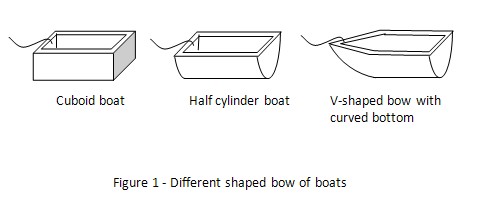
 

boat bow design science fair project


2.    The 3 boats are made of  wood, as shown according to  figure 1 above. The approximate dimensions of the boats are 250mm in length and 80mm in width.
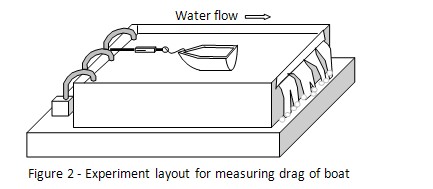
 

water drag science project


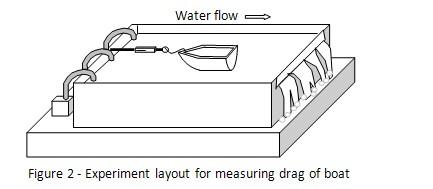
3.    The two water tanks are arranged as per figure 2 above. A 20mm cut is made on the shorter side of the inner tank as shown. This will determine the direction of the water flow. Fill both tanks with water.

4.    Place three water pumps outside the water tank as shown. The water will be pumped into the inner tank, on the side that has not been cut. When the pumps are turned on, the water will flow from one end of the inner tank to the opposite end.

5.    Fix the he cuboid wooden boat and Newton spring balance into the inner tank as shown. Place the  300 grams weight  inside the wooden boat to stabilize it. Turn on the 3 pumps.  Record The measurements on the Newton spring balance in the table provided below.

6.    Repeat step 5 using the half cylindrical shaped and the V-shaped boats. The measurements of the Newton spring are recorded in the table provided below.
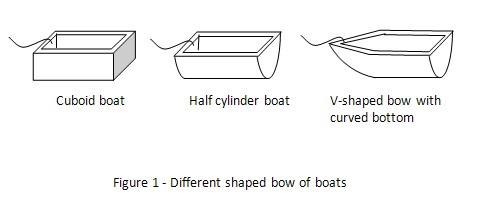
 

b1.jpgb2.jpgb3.jpg

Results

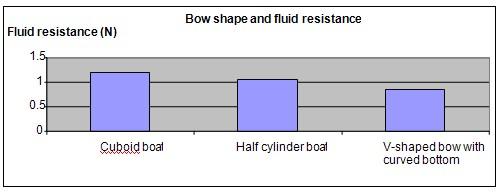
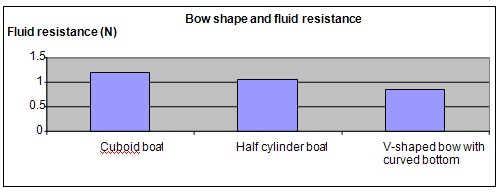
The results show that the boat with the V-shaped bow and the  curved bottom had the least amount of fluid resistance in  water. The cubiod shaped boat had the most  fluid resistance.


Boat bow shape Cuboid boat Half cylinder boat V-shaped bow, curved bottom
Fluid resistance in water (N) 1.2 1.05 0.85

The graph below represents the results of our science experiment
 

aerodynamics science fair project

Conclusion

The hypothesis that a  boat with a V-shaped bow and a curved bottom will have the least amount of fluid resistance, is proven to be true.

The study of fluid dynamics is useful in developing more fuel efficient  boats and planes.
 

Also consider

This science project can be repeated by varying the number of water pumps to simulate varying flow rates.

This experiment can also be repeated using different weights placed in the boat.

References

Bow (ship) – http://en.wikipedia.org/wiki/Bow_(ship)

Buoyancy - http://en.wikipedia.org/wiki/Buoyancy

Drag - http://en.wikipedia.org/wiki/Drag_(physics)

Related videos

These videos explain the science behind this project and demonstrate key concepts used in the experiment.
Share this Science Project:

Related Science Fair Project Ideas

Javelin Release Angle and Distance
Film trained athletes throwing javelins at six different angles to discover which release angle produces the longest throw.
Hard
Bat Material and Ball Bounce at Equal Swing Speed
Mount a bat on a stand and fire baseballs at it to test whether material matters without a batter.
Hard
Gravitational Attraction with an Ancient-Style Torsion Balance
Suspend a pine beam with vegetable fibre and detect gravitational pull between lead weights and stone masses.
Hard