Hypothesis
Flies and cockroaches have more germs on them than the ants or beetles.
Overview
Insects and diseases
Most insects carry bacteria, viruses and parasites on their bodies. When these insects come into contact with people or when they bite/sting, they leave behind many types of germs. Some of these germs cause diseases. Insects like mosquitoes, some species of flies, beetles and fleas spread diseases when they suck on the blood of a diseased person and then bite or feed on a healthy person.
Very few diseases are actually caused by the bite of the insects. More often than not, it is the disease causing microorganisms or pathogens that are passed on to people when they are bitten by the insects that carry these diseases.
Houseflies are known to carry millions of microorganisms on their feet. They pick up microorganisms when they sit on feces. These microorganisms are passed to a person when he consumes food and drinks that the house flies contaminate. This is how people contract typhoid and cholera. Cockroaches are also known to thrive in filthy environments and are very capable of spreading diseases. Mosquitoes are known to cause dengue fever and malaria. The Tsetse fly carries a type of protozoa that is known to cause "sleeping sickness".
Scientific Terms
Insects, germs, bacteria, virus, parasites, pathogens
Conclusion
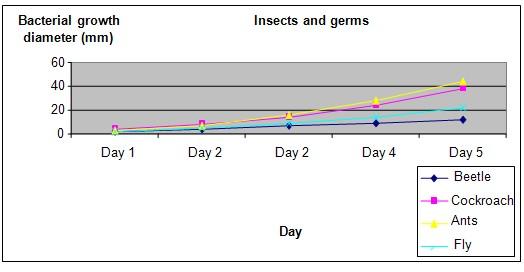
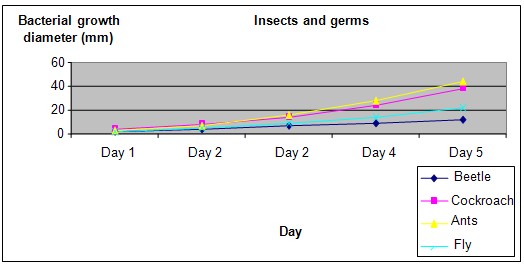
The hypothesis that flies and cockroaches have more germs on them is proven to be only partially correct. The cockroach and the ant had the highest amount of bacteria, followed by the fly, and finally the beetle.
When insects like mosquitoes bite and suck our blood, they inject some of their saliva into our skin to prevent our blood from clotting. This helps facilitate the feeding precess. This is how disease- causing germs enter our bodies- through the mosquitoes’ saliva. However, some insects like bees and wasps have stings that cause pain, but do not spread any disease.
Also consider
The science fair project can be repeated by using other types of insects like dragon flies, bed beetles or spiders.
Try to repeat the experiment by capturing flies from various locations like a garbage dump, near animal feces, within the house, or in the garden and compare the amount of germs in them.
Also, have you considered the body sizes of the insects? Perhaps the cockroach has more germs than the ant because it has a larger body size and hence a larger surface area to carry microorganisms? A more accurate way to assess which insects are "dirtier" is to compare a certain quantity of insects that it takes to cover a certain surface area.
References
Insect borne diseases - http://www.traveldoctor.co.uk/insects.htm
Insects transmit germs - http://purpleslinky.com/trivia/science/insects-transmit-germs/
Insect borne-disease - http://www.watchtower.org/e/20030522/article_01.htm
Related videos
These videos explain the science behind this project and demonstrate key concepts used in the experiment.