Search for Science Fair Projects

1000 Science Fair Projects with Complete Instructions

Bat Material and Ball Bounce at Equal Swing Speed

Bat Material and Ball Bounce at Equal Swing Speed

Hard
Share this Science Project:
This page contains full project details. For the summary, please see the Project Summary.

Science Fair Project Description

This science fair project was undertaken to compare the performance of aluminum and wooden baseball bats if the bats were to be swung at the same speed.
Complexity level:8
Project cost ($):50
Time required:1 hour to prepare, 1 day for science fair project
Material availability:Access to a baseball pitching machine
Safety concerns:

Hypothesis

The distance traveled by the ball will be the same if an aluminum bat and a wooden bat is swung at the same speed.

Overview

Baseball bats were originally made from wood. However the wooden bats have one big disadvantage - they break fairly easily and send splinters flying. Aluminum bats were introduced in the 1970s and were initially adopted by the Little League and later by the amateur leagues.

Wooden bats are heavy and therefore allows a batter to hit the ball harder. The harder the bat and the faster the swing, the harder the ball will be hit and the further it will fly. The center of gravity of the wooden bat is located further away from the hand making it feel heavy near the end. Wooden bats are also better for the batter’s hand because they produce less vibration.

Aluminum bats are light in weight and hollow on the inside. These bats are easier to control. Their lightness also means the batter will require less time to execute the swing. The center of gravity of the aluminum bat is closer to the hand,

For an experienced player, the wooden bat is packed with more power and this allows the player to drive his ball further. Aluminum bats, on the other hand, are easier to use and provide the batter some additional time to adjust the swing.

Scientific Terms

Center of gravity

Materials

The materials required for the science fair project:
- 1 metal stand to hold the baseball bat.
- 1 baseball pitching machine (you might be able to borrow this from your school’s baseball team)
- 1 wooden baseball bat
- 1 aluminum baseball bat
- 2 dozen baseball balls
- Measuring tape
- 1 assistant

MEL Physicshands-on physics experiment kits delivered monthly — real experiments, not just reading. (Affiliate link)

See whats included

Procedure

1. For this science fair project, the independent variable is the use of aluminum or the wooden bat. The dependent variable is the distance traveled by the ball. This is determined by measuring the distance using a measuring tape. The constants (control variables) are the speed of the ball from the pitching machine, the distance of the pitching machine from the bat and the type and weight of baseballs used.

2. The aluminum baseball bat is fixed on a metal stand. The stand is firmly mounted to the ground.

3. The baseball pitcher is positioned about 2 meters away from the bat. The nozzle of the pitcher is aimed at the baseball bat. Adjustments are made until the balls from the pitcher are able to repeatedly hit the baseball bat.

4. The science experiment is started by dispensing the balls from the ball pitcher.  The balls will hit the bat bounce off its surface. The distance traveled by the  ball is measured using the measuring tape, with the help of the assistant. The distance is recorded in the table below. The bat is inspected to see if it has moved and it is adjusted, if required. The test is carried out a total of10 times and the measurements are recorded

5. Procedures 2, 3 and 4 are repeated using the wooden bat and all measurements are recorded in the table.

b1.jpg

Results

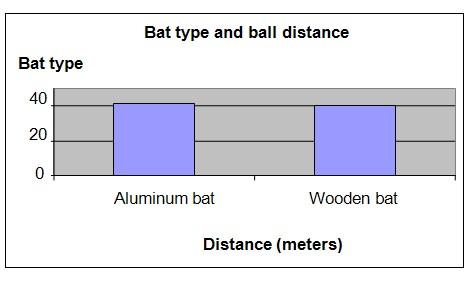
The results show that the distance traveled by the ball was the same, regardless of whether an aluminum bat or wooden bat was used.

Bat Type

Distance traveled by the ball (meters)

Average (meter)

1

2

3

4

5

6

7

8

9

10

Aluminum bat

42.6

40.5

41.4

42.6

39.6

42.2

41.9

38.7

40.5

39.3

40.93

Wooden bat

42.7

39.3

38.6

42.1

40.6

42.1

39.7

38.5

40.7

41.3

40.56

The graph below represents the results of our science experiment.
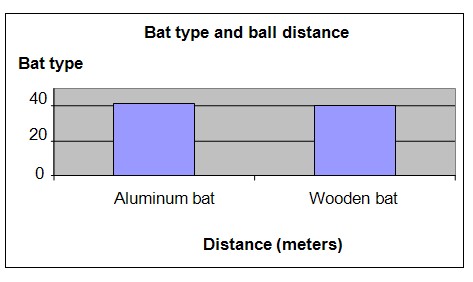
 bat type and ball distance experiment

Conclusion

Although in our experiment, the bats were not swung, we were able to ensure that the speed, at which the balls hit each of the bats, was constant (using the baseball pitching machine). This simulates a baseball player swinging a bat at a constant speed. In our experiment, the distance traveled by the balls was similar (no significant difference). Hence, the hypothesis that the distance traveled by a baseball will be the same, if an aluminum bat and wooden bat were to be swung at the same speed, is proven to be true.

Younger generations of baseball players are growing up using only aluminum bats and are unfamiliar with wooden bats. Better aluminum bats are being created, that allow players to be able to hit balls faster and further.

Also consider

The science fair project can also be performed by comparing different brands of wooden and aluminum bats.

This science project can also be modified to test the distance traveled for different speed settings on the machine.

References

Aluminum bats vs wooden bats - http://en.wikipedia.org/wiki/Aluminum_Bats_vs._Wood_Bats

Aluminum vs wood bats - http://www.newton.dep.anl.gov/askasci/phy00/phy00259.htm

Aluminum or wooden base ball bats - http://www.essortment.com/hobbies/aluminumwooden_spdb.htm

Related videos

These videos explain the science behind this project and demonstrate key concepts used in the experiment.

Share this Science Project:

Related Science Fair Project Ideas

Boat Bow Shape and Water Drag
Build three wooden boats with different bow shapes and measure which one creates the least drag in flowing water.
Hard
Javelin Release Angle and Distance
Film trained athletes throwing javelins at six different angles to discover which release angle produces the longest throw.
Hard
Gravitational Attraction with an Ancient-Style Torsion Balance
Suspend a pine beam with vegetable fibre and detect gravitational pull between lead weights and stone masses.
Hard