Search for Science Fair Projects

1000 Science Fair Projects with Complete Instructions

Hamster Biological Clocks: Singles vs. Pairs

Hamster Biological Clocks: Singles vs. Pairs

Hard
Share this Science Project:
This page contains full project details. For the summary, please see the Project Summary.

Science Fair Project Description

This science fair project was conducted to find out how the biological clocks of singles and couples adjust to changes in the environment. The science experiment involved shifting daylight hours for single hamsters and paired hamsters.
Complexity level:7
Project cost ($):40
Time required:1 day to prepare, 10 days for the science project experiment
Material availability:Hamsters may be purchased from a pet store
Safety concerns:

Hypothesis

Single hamsters adjust more quickly to changes in daylight.

Overview

Biological clocks

All of us lead our lives according to a biological clock. This applies to people, animals and yes, plants. Our biological clock tells us when we should rise, take our meals, perform our chores and go to bed. Our bodies become adjusted to these routines which become “programmed” into our biological clock.

This biological clock can also be reset as and when the need arises. This happens, for example, when we travel overseas to different time zones. What is seen by our eyes and what is felt by our bodies will not be in agreement. The normal rhythm of eating working and sleeping is disturbed and it may take a few days for the body to adjust to the new time zone/routine. Another example of resetting the biological clock is when a person works night shifts. They will cease their normal pattern and adjust their biological clocks to sleep in the day and work at night.

When experiencing jet lag or adjusting to new work shifts, a person may suffer from symptoms like being unable to sleep, loss of appetite, headaches or depression. This is because our biological clock has programmed our body to regulate our sleep times, food digestion, blood pressure levels, body temperatures and hormone secretions

Scientific Terms

Biological clock, blood pressure, body temperature and hormone secretions.

Materials

The materials required for this science fair project:
- 2 closed rooms
- 4 hamster cages with exercise wheel
- 6 hamsters
- 2 lamps with timers
- 2 dim red LED nightlights
- 2 stopwatches
- 2 assistants

Procedure

1. For this science fair project, the independent variable is whether the hamsters were examined alone, or in pairs, in the cage. The dependent variable is the average amount of time the hamsters spent on the exercise wheels. This is determined by observation and recording the timing using the stopwatch. The constants (control variables) are the shift in the daylight hours, the number of hamsters used and number of daylight hours.

2. The cages are labeled P1, P2, S1 and S2. One hamster is placed in each of the cages labeled P1 and P2. Two pairs of hamsters are placed in the cages marked S1and S2.

3. For the first 5 days, the cages are kept in the same room and the lights are turned on for 12 hours and off for the balance 12 hours. When the lights are off, the dim red LED lights are turned on. The average amount of time spent by the hamsters on the exercise wheel within a period of one hour, is calculated and recorded in the table below.

For a single hamster, Average time on wheel = Total amount of time the wheel is used / 1 hamsters (minutes)

For paired hamsters, Average time on wheel = Total amount of time the wheel is used / 2 hamsters (minutes)

4. On the sixth day, when the lights are switched off for after 12 hours, the hamsters in cage P2 and S2 are transferred to the second room. They are allowed to stay in the dark for 1 hour before the light is switched on again for the next 12 hours and after that, turned off for 12 hours (remember to turn on the dim red LED lights). The hamsters in cages P2 and S2 will follow this new schedule for the next 5 days. The average time spent by the hamsters on the exercise wheel per day is calculated as shown in procedure 3 and recorded in the table below.

5. The hamsters in caqes P1 and S1 should follow their original “day” schedule. Record the average time spent by  them on the exercise wheel .

b1.gif

Results

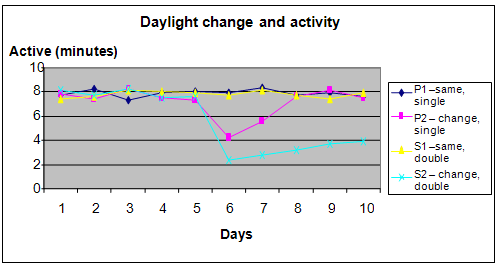
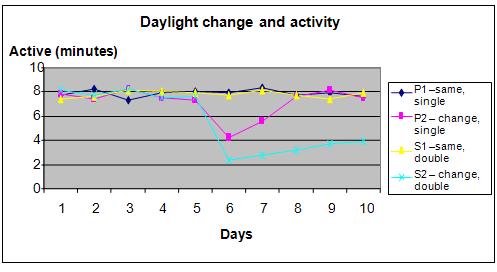
It  was  observed that the hamsters in cages P1 and S1,  did not show any significant behavioral change. However the hamsters in S2 had adjusted quickly to the daylight changes while the hamsters in P2  were slower to adapt to the change.

Hamster Group

Average time spend by hamster on the wheel (minutes)

1

2

3

4

5

6

7

8

9

10

P1 –same, single

7.7

8.2

7.3

7.9

8.0

7.9

8.4

7.7

7.9

7.6

P2 – change, singe

7.8

7.4

8.2

7.5

7.3

4.2

5.6

7.6

8.1

7.5

S1 –same, double

7.4

7.6

8.1

8.0

7.9

7.7

8.1

7.7

7.4

7.9

S2 – change, double

8.1

7.7

8.2

7.5

7.6

2.4

2.8

3.2

3.7

3.9

The graph below represents the results of our science experiment
biological clock science fair project

Conclusion

The hypothesis that  single hamsters  adjust faster to  changes in  daylight is proven to be true.

The biological clock is believed to be an important part of the evolution and survival of species. Nocturnal animals with poor vision in the day, are biologically “programmed” to hide and sleep during the day, so that they are not vulnerable to their predators.

Also consider

What would happen if this science fair project were to be repeated using different types of animals like mice or cats?

The science project can be repeated to evaluate different activities like sleeping and feeding times.

References

Jet lag - http://en.wikipedia.org/wiki/Jet_lag

Do pets suffer jet lag - http://animals.howstuffworks.com/pets/pet-travel/pets-suffer-jet-lag.htm

What is your biological clock? - http://www.essortment.com/all/clockbiological_rtpx.htm

Related videos

These videos explain the science behind this project and demonstrate key concepts used in the experiment.
Share this Science Project:

Related Science Fair Project Ideas

Roosters, Hens, and Obstacle Speed
Time roosters and hens racing to a food tray with and without a log obstacle to see which group adapts faster.
Hard
Mouse Gender, Maze Speed, and Paw Preference
Race male and female mice through a cardboard maze, then use a T-maze to discover each mouse's paw preference.
Hard
Maze Learning in Hamsters and Mice
Build a cardboard maze, send hamsters and mice through it ten times each, and discover which species learns the route faster.
Hard