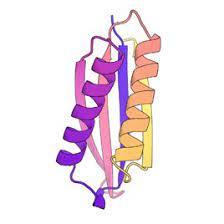
Why does nature fold proteins into helices and strands instead of stretching them out flat? The answer involves energy. Folded shapes pack atoms closer together, creating stronger attractions.
You use computer software to build model peptides (short protein chains) from repeating amino acid blocks. Each peptide is modeled in three shapes:
- extended
- strand
- helix Then you compare their potential energies.
Helices turn out to be the most stable shape. Strands come second. Extended conformations are the least stable. The gap in stability grows as more amino acid blocks are added. Van der Waals forces (weak attractions between nearby atoms) contribute the most to this difference.
Hypothesis
The hypothesis is that nature prefers strands and helices in building biomolecules.
Protein folding is the process by which a protein chain bends into a specific shape that determines whether it can do its job. When a chain folds into structures like helices, atoms pack closer together, strengthening the attractions between them through van der Waals forces. This experiment uses computer software to build model peptides in extended, strand, and helix configurations, then compares their potential energies to show why folded forms are more stable.
When a peptide folds into a helix, its atoms pack closer together, and that proximity strengthens the Van der Waals pulls between them. By measuring the potential energy of each shape, you can see how these individually weak forces accumulate into a meaningful contribution to the structure's stability.
Amino acids are the small building blocks that snap together to form proteins. In this project, you build model peptides from repeating amino acid units, then measure how stable each shape is. The stability gap between different conformations grows wider as more blocks are added — a pattern that reveals how chain length influences molecular structure.
Method & Materials
You will use a computer to make model peptides with repeating pentapeptide blocks of the type of [AAAAA](n) and [DAAAK](n). You will model extended, strand, and helical structures and measure and compare the stabilities of the peptides with and without energy minimization.
You will need a computer, the programs Insight II, IsisDraw, and DeepView.
Eureka Crate — engineering & invention kits for ages 12+ — monthly projects that build real-world skills. (Affiliate link)
The results showed that helix is in general the most stable conformation, followed by strand, whereas the least stable is the extended conformation. The van der Waals term contributed the most to the increase in stability and to a lesser extend the electrostatic term.
Why do this project?
This science project is interesting because it shows how nature prefers strands and helices when building biomolecules.
Also Consider
Experiment variations to consider include testing different types of peptides and varying the number of amino acid blocks.
Full project details
Additional information and source material for this project are available below.